ZK Proofs and AI for Fraud-Proof Web3 Bounty Verification

In the sprawling ecosystem of Web3 bounties, where developers chase rewards for uncovering vulnerabilities or completing tasks, fraud lurks as a persistent shadow. Sybil attacks, fake submissions, and unverifiable claims erode trust, inflating costs and deterring genuine participants. Enter ZK proofs AI bounty verification: a fusion of zero-knowledge proofs and artificial intelligence that promises fraud-proof Web3 bounties. This isn’t mere hype; recent launches like zkVerify’s mainnet underscore a maturing infrastructure ready to redefine web3 task verification zk.


Traditional bounty platforms grapple with opacity. Bounty hunters submit proofs-of-work, but validators face dilemmas: manual reviews scale poorly, while automated checks invite gaming. AI noise exacerbates this, as generative models churn out plausible fakes. Forbes highlights how these pain points – verification delays, researcher distrust – signal systemic fatigue in bug bounty programs. Yet, zero-knowledge proofs flip the script. They enable claimants to prove task completion cryptographically without exposing sensitive details, aligning perfectly with privacy-preserving zk bounties.
ZKVerify Mainnet: Pioneering Cost-Effective Proof Aggregation
Launched in September 2025, zkVerify’s dedicated blockchain marks a watershed for ai zk task proofs. Unlike Ethereum’s prohibitive gas fees for proof verification, zkVerify slashes costs across chains and systems. This aggregator verifies ZK proofs at fractions of the price, empowering bounty platforms to scale without compromise. Imagine a decentralized app posting a smart contract audit bounty: hunters generate ZK proofs attesting to their findings, submitted on-chain for instant, trustless validation. No more off-chain disputes; the math enforces honesty.
This technical leap dovetails with BlockBounty’s model. Their platform leverages ZK for private reports, storing hashes in a vector database for AI-powered similarity searches. Vulnerabilities get tracked sans exposure, ensuring fair payouts. It’s a blueprint for fraud proof web3 bounties, where AI sifts patterns in proof metadata while ZK guards the payloads.
zkMe and Polyhedra: Identity Without Compromise in Bounty Hunts
Identity fraud plagues bounties, especially in high-stakes bug hunts. Enter zkMe’s zkKYC, blending ZK proofs with FATF-compliant identity checks. Users prove eligibility – unique human, compliant jurisdiction – without doxxing. Bounty issuers query these proofs on-chain, filtering bots and repeat claimants seamlessly. Polyhedra’s EXPchain testnet V3 extends this to zkML, the first practical zkML testnet. Developers test hardware-accelerated proofs for AI inferences, like scoring bounty submissions for legitimacy. Polyhedra iD verifies identities sans personal data leaks, fortifying privacy-preserving zk bounties.
These tools address core frictions. In bug bounties, researchers hesitate sharing zero-days publicly; ZK encryptions let them prove impact privately. AI augments by analyzing proof circuits for anomalies, flagging deepfake attempts or recycled exploits. Subnet 2’s Immunefi bounties already verify AI model computations via ZK, ensuring inferences match claimed outputs. The result? High-fidelity ZK proofs AI bounty verification that scales with Web3’s demands.
Zircuit’s AI Rollup: Securing Bounties at Layer 2
Zircuit’s AI-powered L2 rollup targets DeFi vulnerabilities head-on, a boon for bounty ecosystems. By embedding AI into rollup mechanics, it preempts exploits through predictive verification. Bounty hunters probe these rollups, generating ZK proofs of discovered flaws. AI triages submissions, prioritizing high-impact ones for human review. This hybrid vigilance – cryptographic rigor plus machine intelligence – curtails fraud vectors like MEV attacks or oracle manipulations.
Consider the broader canvas: HackMD’s ZKML bridges AI/ML to Web3, privacy intact. Orochi Network harmonizes ML with data privacy via ZK, applicable to bounty scoring models. CoinDesk posits ZKPs as AI agents’ identity backbone, essential for autonomous bounty fulfillment. Humanity Protocol’s zkProofers verify legitimacy sans details, echoing Proof of Trust against AI-driven fraud. Together, they forge web3 task verification zk that’s not just secure, but efficient and equitable.
These integrations reveal a nuanced truth: ZK alone verifies; AI contextualizes. In Web3 bounties, where stakes run into millions, this duo dismantles distrust. Platforms like zkverifiedtasks. com exemplify it, using AI analysis with ZK proofs for anti-spam, privacy-preserving rewards. The trajectory points to bounties where fraud isn’t mitigated – it’s mathematically impossible.
Critics might dismiss these advancements as computationally intensive, but zkVerify’s proof aggregation demonstrates otherwise, dropping verification expenses to pennies per proof. This efficiency unlocks ai zk task proofs for everyday bounties, from code reviews to content moderation tasks. Platforms like zkverifiedtasks. com operationalize this by parsing submissions through AI models trained on historical fraud patterns, then packaging outputs into ZK-SNARKs for on-chain attestation. The result is tamper-evident verification that scales linearly, even as bounty volumes explode.
Practical Integration: From Submission to Payout
Picture a developer targeting a DeFi bounty on zkverifiedtasks. com. They audit a protocol, document flaws, and feed evidence into an AI validator. The model scores novelty and severity, generating a succinct proof input. A ZK circuit then attests: “This submission matches the AI’s vetted output, derived from unique inputs. ” Submitted on-chain, the proof triggers payout without revealing exploits or personal data. BlockBounty’s vector database enhances this, enabling semantic searches across encrypted reports to detect duplicates instantly. Such workflows eradicate Sybil farms and plagiarized claims, hallmarks of fraud proof web3 bounties.
ZK-AI Bounty Verification: Precise 4-Step Protocol for Hunters
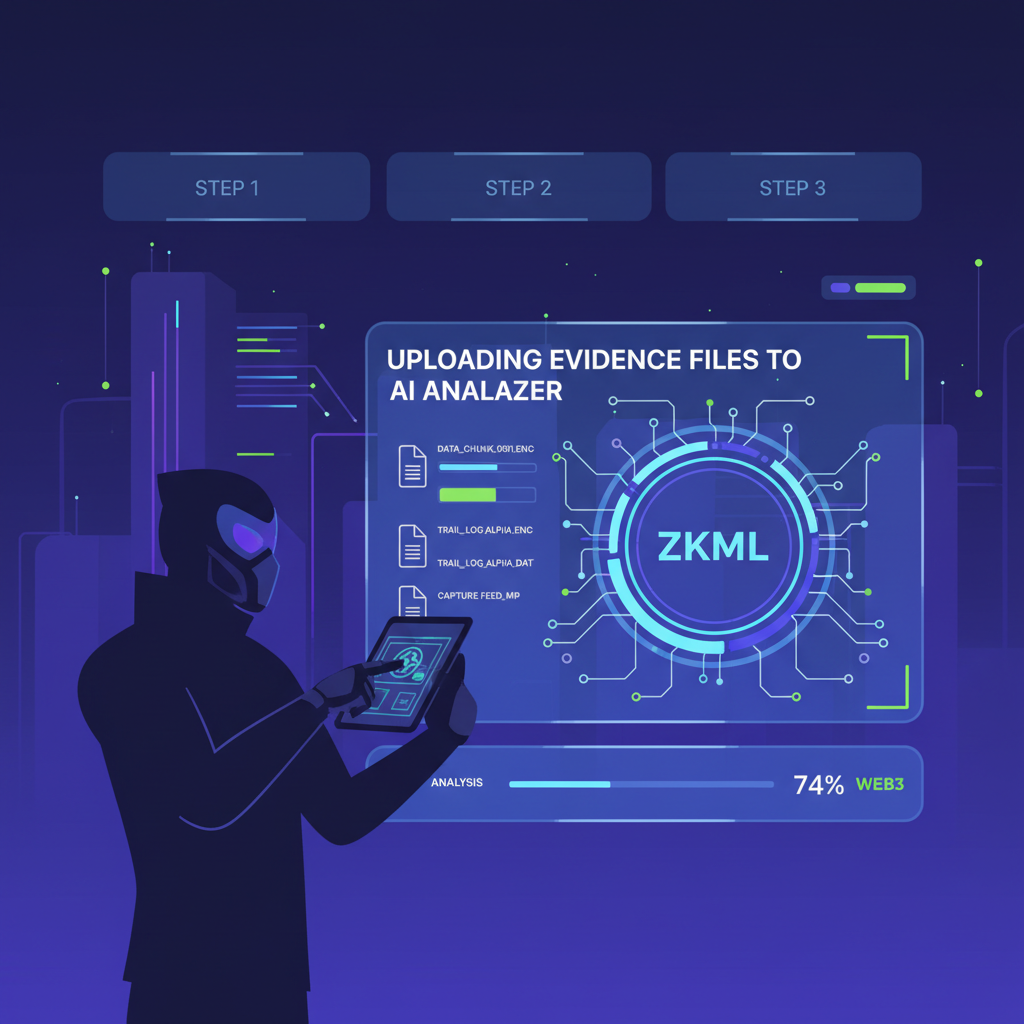
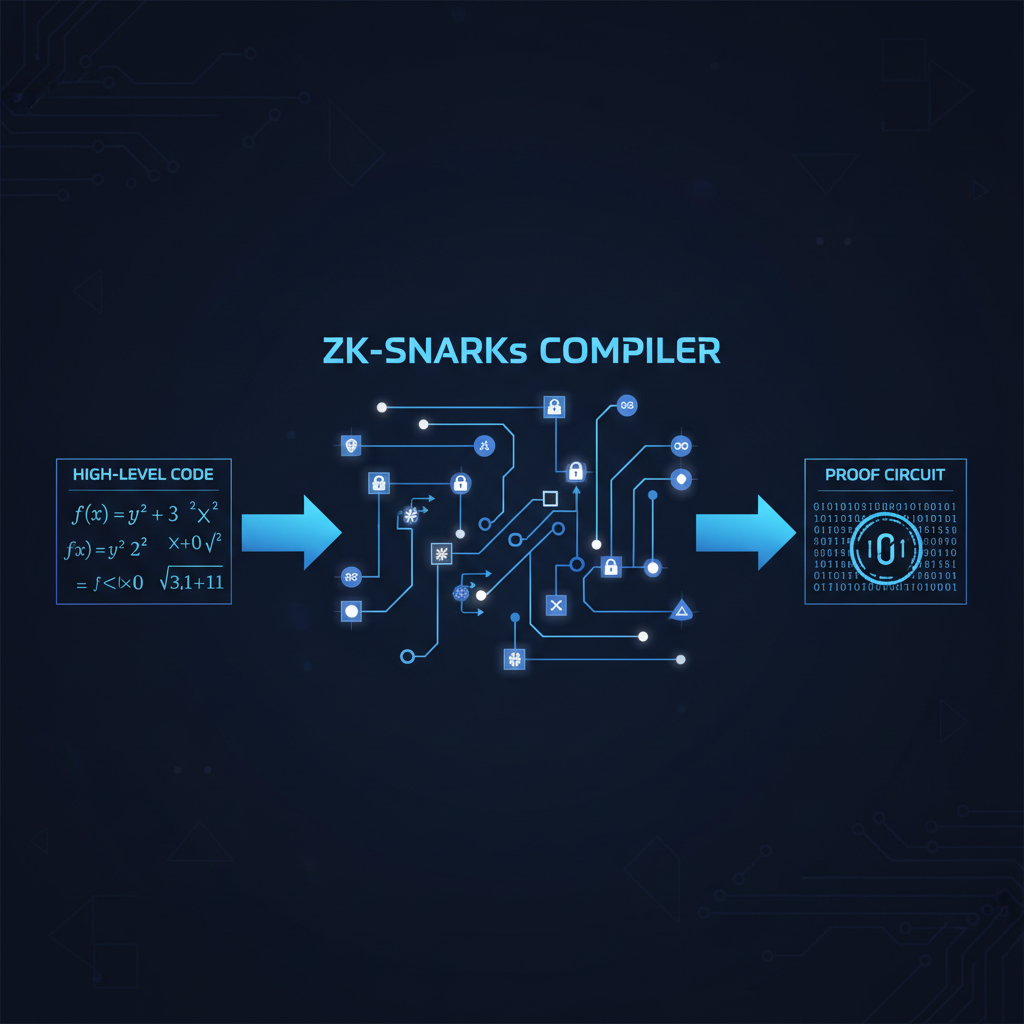
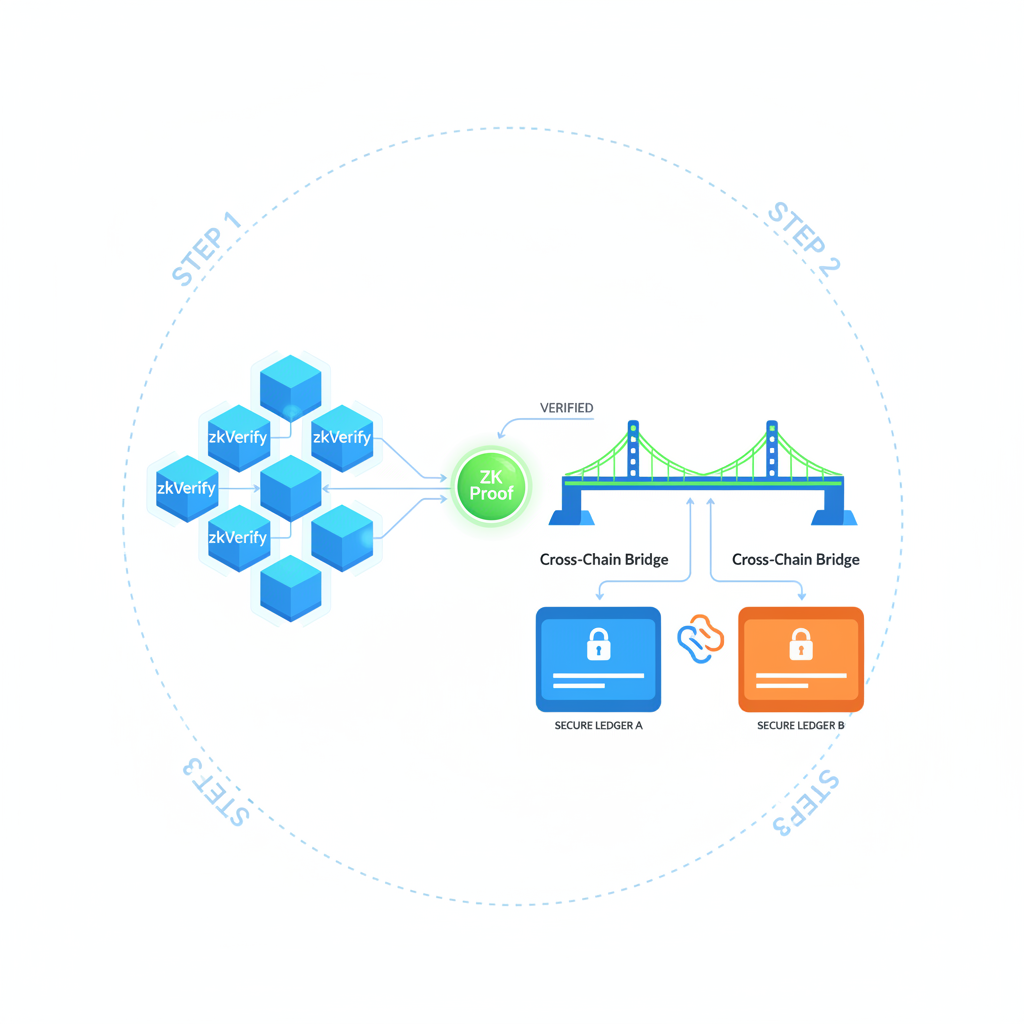
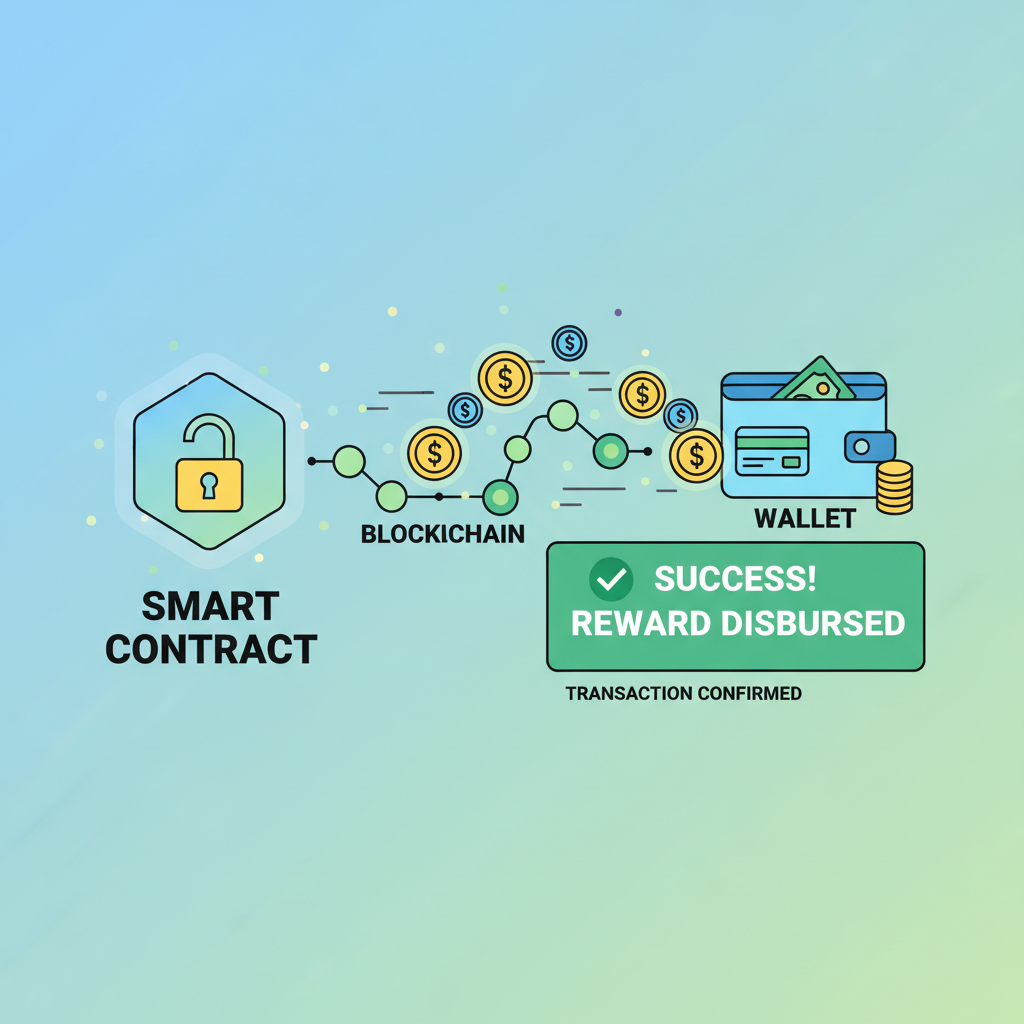
This isn’t theoretical; Immunefi’s Subnet 2 bounties already enforce ZK-checked AI inferences, ensuring model outputs align with computations. Orochi Network’s ZK-ML fusion similarly empowers private fraud detection, where AI flags anomalies in bounty metadata without accessing payloads. Opinionated take: traditional platforms cling to centralized oracles, breeding collusion risks. ZK-AI hybrids sidestep this entirely, enforcing verifiability at the protocol layer.
Identity remains the linchpin. zkMe’s zkKYC and Humanity Protocol’s zkProofers provide sybil-resistant credentials, proving “one human, one bounty” sans biometrics. Polyhedra iD on EXPchain testnet V3 accelerates this with zkML, inferring eligibility from encrypted traits. Zircuit’s AI L2 rollups layer predictive defenses, where bounties proactively hunt emerging threats. Together, they craft ecosystems where privacy-preserving zk bounties thrive, rewarding merit over manipulation.
Advancements in ZK-AI Bounty Tech
| Platform | Key Feature | Impact |
|---|---|---|
| zkVerify | Proof Aggregation & Mainnet Launch | Cost reduction up to 90% vs Ethereum; first dedicated ZK proof verification blockchain |
| BlockBounty | Private Reports | Duplicate prevention; AI-powered vulnerability tracking with secure storage & fair rewards |
| zkMe | zkKYC Service | Sybil resistance; FATF-compliant private identity verification |
| Polyhedra | zkML Testnet (EXPchain V3) | AI inference proofs; hardware-accelerated for real-world apps like privacy-preserving ID |
| Zircuit | AI L2 Rollup | Preemptive security; enhances DeFi vulnerability protection |
Overcoming Hurdles: Scalability Meets Usability
Usability hurdles persist – generating ZK proofs demands tooling fluency. Yet, zkverifiedtasks. com abstracts this via no-code interfaces, where AI auto-generates circuits from natural language tasks. Forbes’ bug bounty critique rings true: AI noise drowns signals. Here, ZK circuits constrain inputs, forcing honesty; AI refines signals pre-proof. CoinDesk’s vision of ZK-backed AI agents materializes in autonomous hunters, self-verifying contributions before submission.
Regulatory headwinds favor this stack. zkMe’s FATF compliance ensures bounties navigate KYC mandates privately, vital as Web3 matures. Humanity’s Proof of Trust counters AI identity fraud, aligning with broader zkProofers for seamless verification. The Medium evolution narrative holds: ZK proofs, once math curiosities, now power web3 task verification zk at scale.
Forward momentum accelerates. zkVerify’s mainnet begets specialized chains for bounty proofs, slashing latency. Polyhedra’s hardware proofs enable real-time zkML, scoring submissions mid-hunt. Zircuit fortifies L2s, where bounties evolve into continuous audits. zkverifiedtasks. com stands at the vanguard, its AI-ZK engine delivering anti-spam rigor for decentralized projects. Developers claim rewards with mathematical certainty; issuers pay precisely. Fraud yields to formality, birthing a bounty renaissance defined by trustless precision and boundless potential.