
What are ZK verified tasks
ZK verified tasks sit at the intersection of zero-knowledge proofs and automated task execution. They allow AI agents and software systems to prove they completed a specific workflow without exposing the underlying data or intermediate steps. This capability is essential for trustless automation in 2026, where privacy and computational integrity are non-negotiable.
Traditionally, verifying a computation required trusting the executor or repeating the work entirely. ZK verified tasks change this dynamic. By generating a succinct cryptographic proof, an agent can demonstrate that it followed a predefined protocol and arrived at a correct result. The verifier only needs to check the proof's validity, not the raw inputs.
This approach is particularly powerful for AI agents operating in multi-agent environments. When an agent performs a task—such as querying a private database or running a sensitive model inference—it can submit a ZK proof alongside the output. Other agents or smart contracts can then trust the result without needing access to the proprietary data or the agent's internal logic. This creates a foundation for secure, scalable automation where trust is derived from mathematics rather than reputation.
The technology relies on the mathematical soundness of zero-knowledge proofs, which provide a rigorous way to verify correctness without revealing inputs. As these systems mature, they enable a new class of applications where privacy and automation coexist seamlessly, moving beyond simple transaction verification to complex, data-heavy computational tasks.
Compare verification architectures
Choosing the right ZK verification model depends on where your data lives, how fast you need finality, and who you trust. The three main approaches—on-chain, off-chain, and hybrid—offer distinct trade-offs in cost, latency, and security assumptions.
On-chain verification
On-chain verification executes the proof check directly on the blockchain via smart contracts. This offers the highest level of security because the network itself validates the result. However, this comes at a high gas cost and significant latency, as every proof must be processed by the consensus layer. It is best suited for high-value settlements where trustlessness is paramount.
Off-chain verification
Off-chain verification relies on a centralized or semi-trusted relayer to validate proofs and submit a summary to the chain. This approach is fast and cheap, making it ideal for high-frequency tasks like gaming or social media feeds. The trade-off is that you must trust the relayer not to censor or manipulate the results. It works well when speed and cost matter more than absolute decentralization.
Hybrid verification
Hybrid models split the workload. The chain handles critical state changes, while off-chain components manage bulk data processing or less critical validations. This balances cost and security, allowing for scalable applications without sacrificing all decentralization. It is often the most practical choice for complex dApps that need both performance and verifiable integrity.
| Feature | On-Chain | Off-Chain | Hybrid |
|---|---|---|---|
| Trust Model | Code-only (Maximal) | Relayer-dependent | Shared Trust |
| Gas Cost | High | Low | Moderate |
| Latency | Slow (Block time) | Fast (API response) | Variable |
| Best For | High-value settlements | High-frequency tasks | Complex dApps |
Implement ZK proofs for agents
Generating and submitting zero-knowledge proofs for automated tasks requires a structured pipeline. You are moving from raw task data to a cryptographic guarantee that the task was completed correctly, without exposing the underlying data. This process involves compiling your task circuit, generating the proof, and finally submitting it to a verifier.
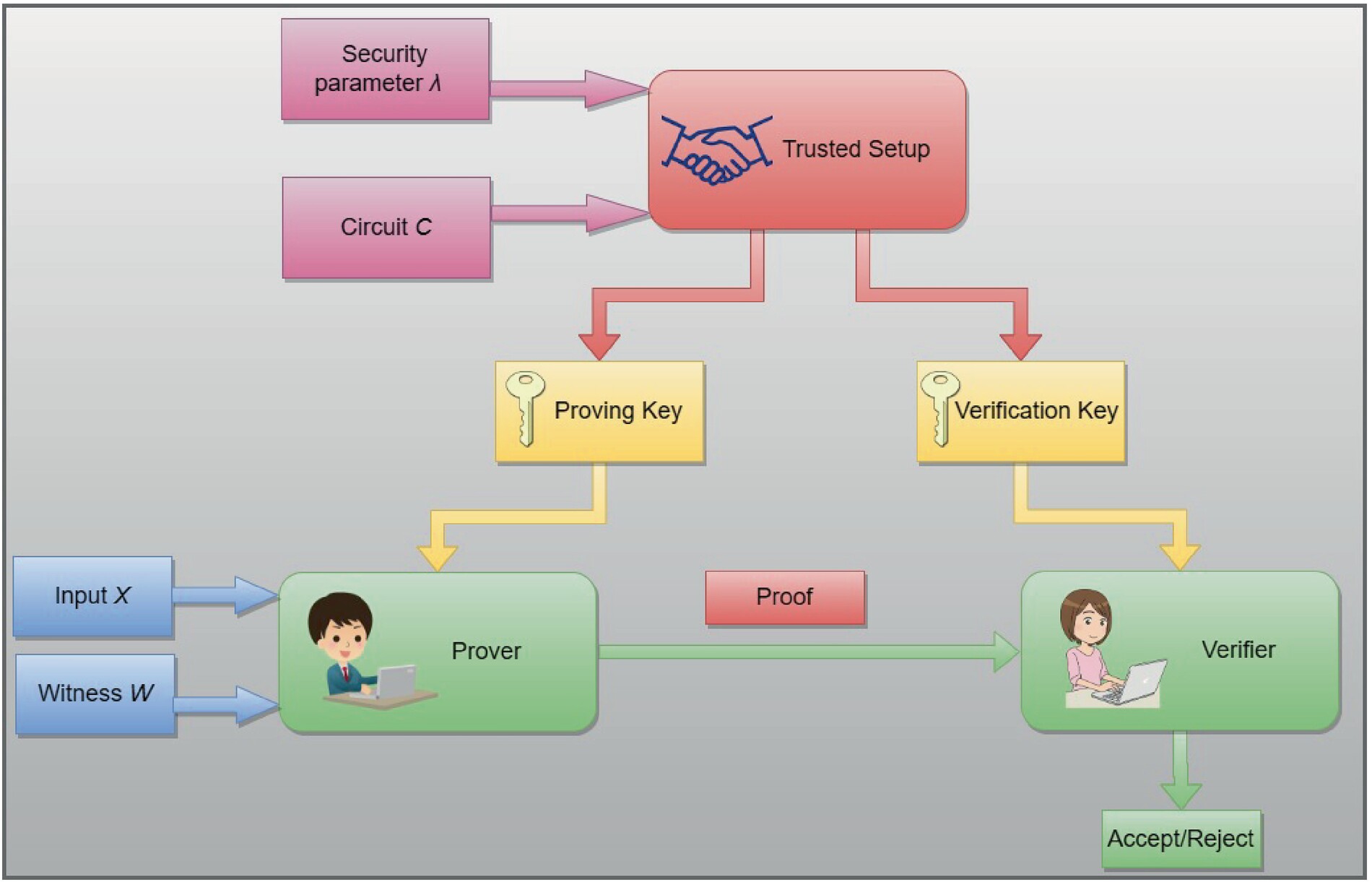
Define your task logic as a circuit. This is a program that describes the computation your agent must perform. The circuit must specify the public inputs (what anyone can see) and private inputs (what remains hidden). Use a ZK framework like Circom or SnarkJS to write this logic. The goal is to create a circuit that outputs a valid proof if the agent’s execution matches the defined rules.
Run your agent’s execution data through the circuit. The prover engine takes the private inputs (the actual task results) and the public inputs (the task parameters) to generate a succinct cryptographic proof. This proof attests that the computation was performed correctly according to the circuit’s constraints. This step is computationally intensive and should be done off-chain to avoid high gas costs.
Send the generated proof and public inputs to a smart contract or a verification service. The verifier checks the proof against the circuit’s verification key. If the proof is valid, the contract emits an event confirming the task was completed correctly. This step is where trustlessness is realized: anyone can verify the proof, but only the agent could have generated it given the private inputs.
This pipeline ensures that your agents can operate autonomously while maintaining verifiable integrity. By following these steps, you can implement ZK verified tasks that provide strong guarantees of correctness and privacy.
Secure your verification workflow
ZK verified tasks rely on the integrity of the underlying circuits. If the proof generation logic contains a flaw, the entire automation layer collapses, regardless of how robust the surrounding infrastructure is. Securing this workflow requires a disciplined approach to auditing and verification.
Audit your circuits rigorously
The first line of defense is a comprehensive audit of your zero-knowledge circuits. This process involves identifying logical vulnerabilities, side-channel risks, and implementation errors in the proof generation code. Professional audits provide a structured way to map out these risks and define actionable recommendations for remediation.
Consider resources like Veridise, which specialize in ZK-specific security assessments. Their audits focus on the unique cryptographic properties of ZK systems, ensuring that your circuits behave exactly as intended under all conditions. A thorough audit is not a one-time event but a critical checkpoint before any ZK verified task goes live.
Implement verification infrastructure safeguards
Beyond the code itself, the infrastructure handling the proofs must be secure. This includes the nodes that generate proofs and the systems that verify them. Ensure that your verification contracts are immutable and that the key management systems used for proving are isolated from public-facing services.
Use a checklist to verify your setup:
-
Circuit logic reviewed by independent auditors
-
Proving keys stored in hardware security modules (HSMs)
-
Verification contracts verified on-chain
-
Fallback mechanisms for proof generation failures
By treating security as a continuous process rather than a final step, you ensure that your ZK verified tasks remain trustworthy and resilient against emerging threats.
FAQ about ZK verified tasks
Is zero-knowledge proof legit?
Zero-knowledge proofs (ZKPs) are a legitimate cryptographic protocol where a prover convinces a verifier that a statement is true without revealing the underlying data. This technology brings trustworthiness to Web3 privacy, allowing systems to verify ZK verified tasks securely. It is not a speculative concept but a mathematical standard used in modern blockchain infrastructure.
How do ZK rollups validate transactions?
ZK rollups use zero-knowledge proofs to validate transactions off-chain. These proofs verify the correctness of a batch of transactions without revealing the actual data on the main chain. This allows ZK verified tasks to scale efficiently while maintaining the security guarantees of the underlying blockchain.
Can existing blockchains use ZK proofs?
Yes. Major networks are integrating ZK technology to support private transactions and scalable verification. For example, the XRP Ledger integrated Boundless, a ZK proving network, to enable native verification of ZK proofs. This demonstrates that ZK verified tasks can be embedded into existing public blockchains without requiring a complete overhaul.
No comments yet. Be the first to share your thoughts!