
Get zk verified tasks right
Before you build, you need to understand what you are actually verifying. Zero-knowledge proof (ZKP) verification is the process of confirming a computation was performed correctly without revealing the underlying data or intermediate steps. It is a mathematically sound method for establishing trust in private transactions or confidential AI outputs.
However, not all ZKP systems are created equal. The ecosystem is fragmented across different proof systems like SNARKs and STARKs, each with distinct tradeoffs in proof size, verification speed, and cryptographic assumptions. For a monetizable agent, your choice dictates whether you can prove a task on-chain cheaply or if you need off-chain attestation.
The ZKProof community maintains a list of verified verifiers to ensure the cryptographic implementations are correct. Using a non-verified or poorly audited verifier exposes your agent to potential fraud or invalid state transitions. Always check the ZKProof verifier registry before integrating a new proof system.
Your agent’s output must be deterministic. If the same input produces different proofs due to non-deterministic code paths, verification will fail. Define your task scope narrowly: specific inputs, fixed algorithms, and clear success criteria. Ambiguity here is the primary reason for failed audits and rejected payouts.
Work through the steps
Before launching an AI agent on ZK Verified Tasks, you must ensure the underlying proof system is both secure and performant. The goal is to prove computation without exposing sensitive data. Follow this sequence to set up a reliable verification pipeline.
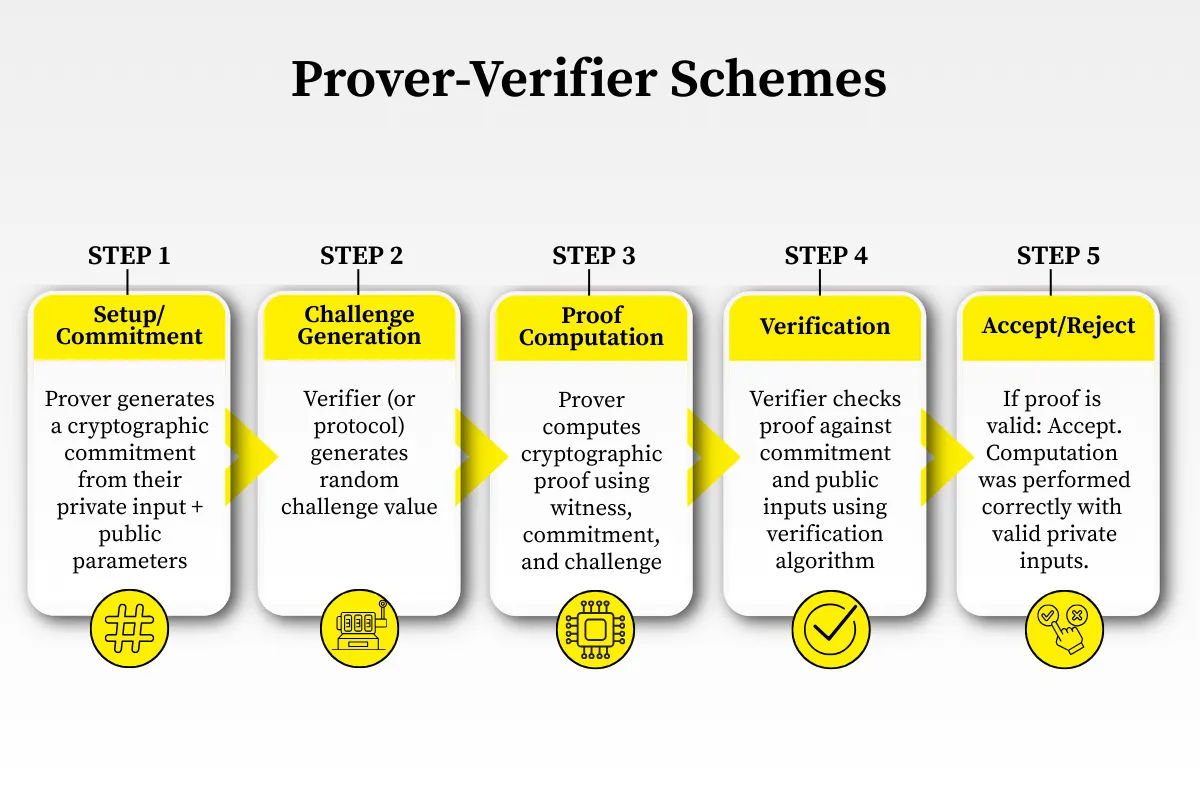
Choose a cryptographic framework that supports your agent’s logic. Popular options include Circom or Halo2. Ensure the framework allows you to compile your agent’s operations into an arithmetic circuit. This circuit is the blueprint for the zero-knowledge proof.
Translate your agent’s decision tree and data processing steps into the chosen circuit. This step requires careful attention to constraints. Each logical operation must be represented as a mathematical constraint. Errors here will cause proof generation to fail.
Run the prover using your private inputs. The prover takes the circuit and your agent’s private data to generate a succinct proof. This proof demonstrates that the agent executed the task correctly without revealing the input data itself. Keep this proof secure.

Submit the proof to a verifier contract or service. The verifier checks the cryptographic validity against the public parameters. If the proof is valid, the task is marked as complete. This step ensures trustless execution for your AI agent’s monetization layer.
Fix common mistakes
Most AI agent projects fail at monetization not because the AI is weak, but because the verification layer is fragile. When you monetize AI agents using zk verified tasks, you are selling trust. If the ZK proof is malformed, the transaction is worthless. Below are the three most frequent errors developers make when integrating zero-knowledge proofs into monetization flows, and how to fix them.
Mismatched circuit limits to account for
The most common technical error is allowing the ZK circuit constraints to drift from the actual agent logic. If your circuit verifies that a task was completed but doesn't strictly enforce the specific output format or resource limits, agents can "cheat" by submitting cheap, low-quality results that still satisfy the mathematical proof.
The fix: Ensure your circuit constraints are tight. Every variable in the agent's execution trace should have a corresponding constraint in the ZK circuit. If the agent processes 1000 rows of data, the circuit must verify that exactly 1000 rows were processed, not just "some" data. Use formal verification tools to test the circuit against edge cases before deployment.
Inefficient proof generation
Agents are often constrained by time and compute costs. If the ZK proof generation takes too long or costs too much in gas, the agent's profit margin disappears. Many developers use generic proof systems that are not optimized for the specific computation the agent performs, leading to excessive overhead.
The fix: Choose a proof system that matches the agent's workload. For simple, repetitive tasks, use a proof system with fast proving times like Halo2 or Gnark. For complex, non-deterministic tasks, consider recursive proofs where a smaller proof verifies a larger one. Always benchmark proof generation times against your agent's expected runtime.
Ignoring verifier compatibility
A proof is only as good as the verifier that checks it. If you generate a proof in a format that the target blockchain or verification service doesn't support, the monetization transaction will fail. This is particularly common when moving between different zkEVMs or L2s, each with unique verification requirements.
The fix: Check the verifier compatibility matrix before writing code. If you are deploying on a specific zkEVM, ensure your proof system generates proofs that the native verifier can accept. Use standardized interfaces like the ZKProof Verified Verifiers framework to ensure cross-chain compatibility. This prevents costly rewrites when scaling to new networks.
Zk verified tasks: what to check next
Before committing resources to ZK-verified workflows, it helps to separate the cryptographic mechanics from the hype. These answers address the practical distinctions that matter for developers and business operators evaluating zero-knowledge systems.
No comments yet. Be the first to share your thoughts!